
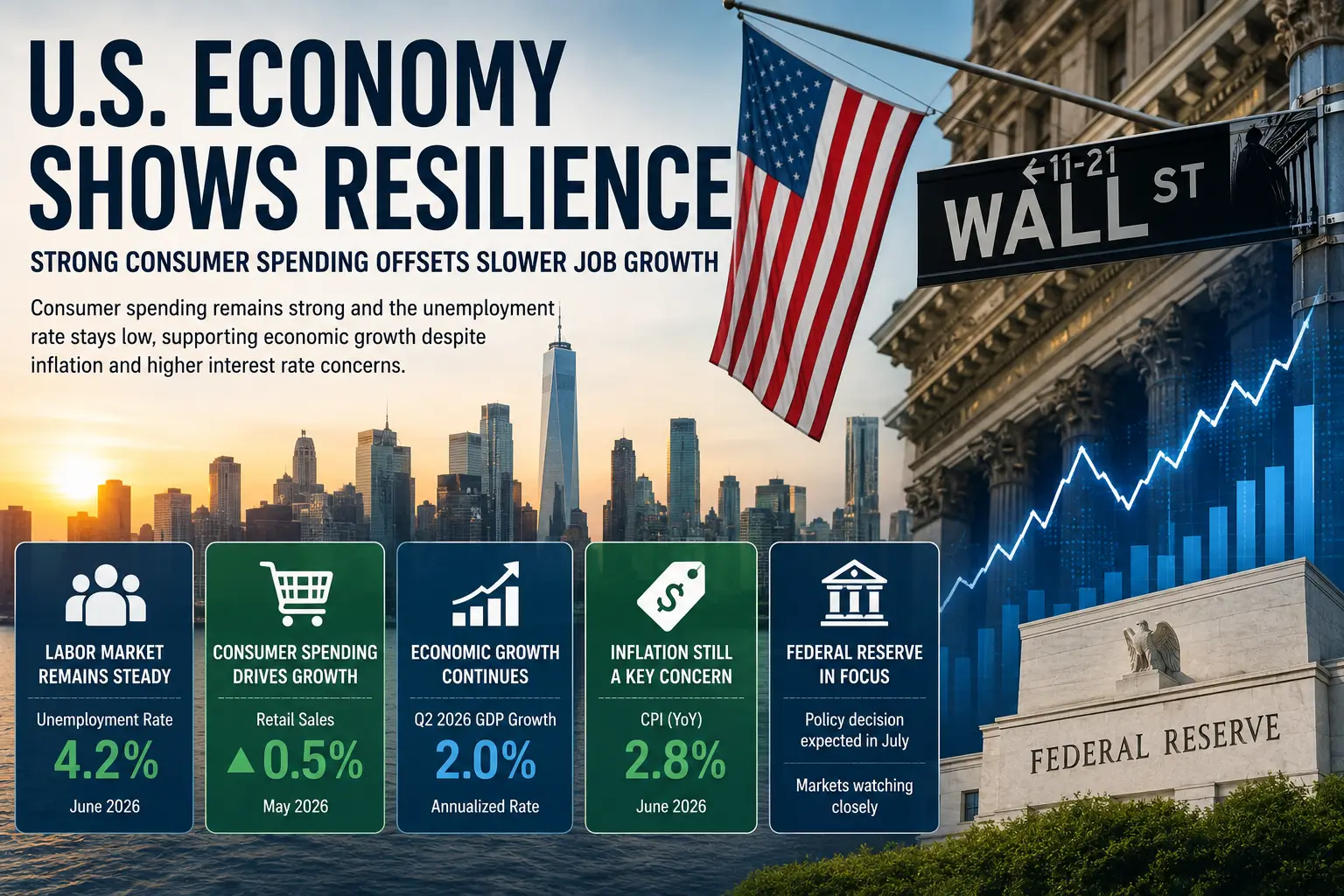
U.S. Economy Shows Resilience as Strong Consumer Spending Offsets Slower Job Growth
AI SUMMARY · SYNTHESIZED FROM 3 SOURCES: U.S. Bureau of Labor Statistics ↗ Federal Reserve ↗ U.S. Bureau of Economic Analysis ↗
The U.S. economy continues to demonstrate resilience despite signs of slower hiring and ongoing inflation concerns. Consumer spending remains a key driver of economic activity, while unemployment stays near historically low levels. Investors are closely watching the Federal Reserve’s upcoming policy meeting as officials weigh persistent inflation risks against moderating economic growth.
What Happened?
Recent economic data paints a mixed but generally stable picture of the U.S. economy.
The labor market remains healthy, with the unemployment rate at 4.2%, although hiring has slowed compared with earlier in the year. Nonfarm payrolls increased by 57,000 jobs in June, below economists’ expectations, suggesting employers are becoming more cautious amid higher borrowing costs and economic uncertainty.
Despite slower job creation, consumer spending continues to support economic growth as households maintain spending on travel, dining, healthcare, and other services.
Labor Market Remains Stable
Although hiring has cooled, layoffs remain relatively limited.
New applications for unemployment benefits recently fell to their lowest level in ten weeks, indicating that most employers are continuing to retain workers despite slower hiring activity. Economists say the labor market is gradually cooling rather than experiencing a sharp downturn.
Average hourly earnings have also continued to rise, helping support household incomes even as inflation remains above the Federal Reserve’s long-term target.
Inflation Still Challenges Policymakers
Inflation has eased from previous highs but remains an important concern for policymakers.
Higher energy prices linked to geopolitical tensions and elevated housing costs continue to pressure household budgets. These factors have complicated the Federal Reserve’s efforts to bring inflation closer to its long-term objective.
As a result, investors remain uncertain about the future path of interest rates. The Federal Reserve is widely expected to carefully evaluate incoming inflation and employment data before making additional policy decisions.
Financial Markets Watch the Federal Reserve
The upcoming Federal Reserve meeting is attracting significant attention from financial markets.
Some analysts believe resilient consumer spending and persistent inflation could justify keeping interest rates elevated for longer. Others argue that slowing job growth and moderating inflation support a more cautious approach.
The outcome of the meeting is expected to influence borrowing costs, mortgage rates, business investment, and equity markets over the coming months.
Business Outlook
Businesses continue investing despite economic uncertainty.
Many companies are increasing spending on:
- Artificial intelligence
- Automation
- Digital infrastructure
- Supply-chain modernization
- Manufacturing efficiency
Corporate leaders remain optimistic about long-term productivity gains, although they continue monitoring labor costs, consumer demand, and financing conditions.
What Investors Are Watching
Markets are closely following several upcoming economic indicators:
- Consumer Price Index (CPI)
- Gross Domestic Product (GDP)
- Retail Sales
- Employment Reports
- Federal Reserve policy decisions
- Consumer confidence surveys
These reports will provide additional insight into whether the U.S. economy continues achieving a “soft landing”—slowing inflation without falling into recession.
Key Takeaways
- The U.S. economy continues expanding despite slower hiring.
- Consumer spending remains the primary driver of economic growth.
- The unemployment rate remains relatively low at 4.2%.
- Inflation and energy prices continue influencing Federal Reserve policy.
- Investors are awaiting additional economic data before reassessing interest-rate expectations.
Why This Matters
The United States remains the world’s largest economy, making its economic performance critical for global financial markets.
Changes in U.S. interest rates, consumer spending, employment, and inflation affect businesses, investors, and governments worldwide. As policymakers attempt to balance economic growth with price stability, upcoming data releases will likely shape market sentiment throughout the second half of the year.
AI Transparency Notice
This article was generated by AI using publicly available reporting and official U.S. economic data. APNews.ai does not conduct original reporting. Readers are encouraged to review the original sources for complete context and future updates.








