
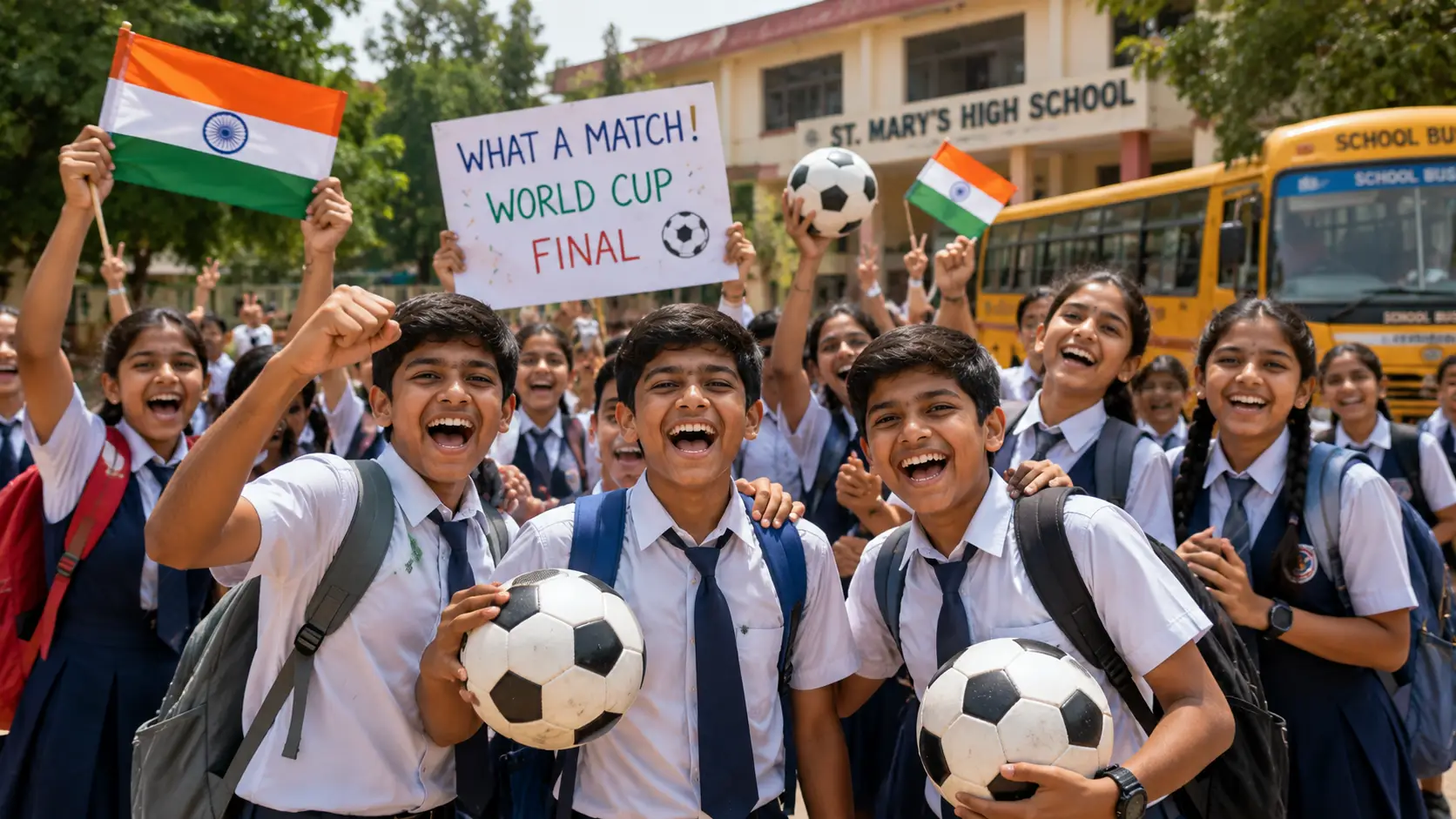
School Holiday Declared After FIFA World Cup Final: Indian States Put Student Well-Being First
AI SUMMARY · SYNTHESIZED FROM 2 SOURCES: Times of India ↗ FIFA ↗
Football is more than just a sport in several parts of India—it is a cultural celebration that brings communities together across generations. That passion was on full display following the FIFA World Cup Final, when the governments of Kerala, Meghalaya, and Manipur announced a one-day holiday for schools and, in some cases, colleges.
The decision came after millions of football fans stayed awake late into the night to watch one of the world’s biggest sporting events. Rather than expecting students to attend classes after only a few hours of sleep, state governments chose to prioritize student well-being, earning praise from parents, educators, and sports enthusiasts.
The move quickly attracted national attention and sparked discussions about how education systems can better respond to significant global events while maintaining academic standards.
Why Were Schools Closed?
The FIFA World Cup Final is among the most watched sporting events on the planet. Because the match was played in a different time zone, viewers in India had to stay awake until the early hours of the morning.
In football-loving states such as Kerala, Meghalaya, and Manipur, many students, teachers, and families watched the match together.
Recognizing that students would likely be tired and attendance could be significantly lower than usual, state authorities announced a holiday instead of conducting regular classes.
Officials stated that the decision was intended to protect student health, improve safety during travel, and allow families to celebrate one of football’s biggest occasions without worrying about school attendance the next morning.
Football Holds a Special Place in These States
Unlike many regions where cricket dominates sports culture, football enjoys enormous popularity across Kerala, Meghalaya, and Manipur.
These states have produced talented footballers who have represented India at both national and international levels. Local football leagues attract large audiences, and young athletes often dream of playing professionally.
Communities regularly organize screenings of international tournaments, and FIFA World Cup matches become major social events.
Education experts say the holiday recognized this unique cultural connection while demonstrating that governments understand the interests of young people.
Positive Response From Students and Parents
Students welcomed the announcement, saying it allowed them to fully enjoy one of the world’s biggest sporting events without sacrificing their health or academic responsibilities.
Parents also praised the decision, noting that many families had watched the match together.
Instead of forcing tired students into classrooms, authorities acknowledged the practical reality that many children would have slept only a few hours before school.
Teachers similarly reported that attendance would likely have been much lower had schools remained open.
Many educators viewed the decision as a thoughtful balance between education and student wellness.
Education and Student Well-Being
The school holiday has also highlighted a broader discussion about student well-being.
Modern education increasingly recognizes that learning depends not only on classroom instruction but also on physical and mental health.
Sleep experts emphasize that children and teenagers require adequate rest to maintain concentration, memory, emotional regulation, and academic performance.
Research consistently shows that sleep deprivation can reduce attention spans, lower learning efficiency, and negatively affect overall health.
By allowing students to recover after a late-night global event, education officials demonstrated growing awareness of these factors.
Can Sports Inspire Better Learning?
Many education specialists believe major sporting events provide valuable learning opportunities beyond entertainment.
Teachers often use international competitions to discuss topics such as:
Geography
Students learn about participating countries, cultures, and host cities.
Mathematics
Tournament statistics, player performance, and match analysis help improve numerical reasoning.
History
Students explore the development of international football and previous World Cup tournaments.
Physical Education
Major competitions inspire young people to participate in sports and adopt healthier lifestyles.
Teamwork and Leadership
Football teaches discipline, cooperation, communication, and perseverance—skills that benefit students throughout their education.
Social Media Celebrates the Decision
News of the holiday quickly spread across social media platforms.
Thousands of users applauded state governments for recognizing football’s importance and placing student welfare ahead of rigid attendance policies.
Many users described the decision as progressive and student-friendly.
Some educators suggested that similar flexibility could be considered for other nationally significant cultural or sporting events when appropriate.
Could Other States Follow?
While the holiday primarily applied to Kerala, Meghalaya, and Manipur, education experts believe other states may observe similar approaches in the future for extraordinary events.
However, officials also emphasized that such holidays remain exceptional rather than routine.
Academic calendars continue to prioritize instructional time, and any adjustments must balance learning objectives with student welfare.
The Growing Role of Student-Centered Education
The decision reflects a broader shift toward student-centered education.
Schools around the world increasingly recognize that flexibility, emotional well-being, and community engagement contribute to better educational outcomes.
Rather than viewing education solely through examinations and classroom hours, many policymakers now support approaches that consider students’ overall development.
This includes mental health, physical wellness, extracurricular activities, sports participation, and family engagement.
Conclusion
The school holiday announced after the FIFA World Cup Final demonstrates how education systems can adapt to exceptional circumstances while placing students first.
For football-loving communities in Kerala, Meghalaya, and Manipur, the decision celebrated a shared cultural passion while acknowledging the importance of health, rest, and responsible learning.
Although the holiday lasted only one day, it sparked an important conversation about balancing academic excellence with student well-being—an issue likely to remain central as education continues to evolve.








