
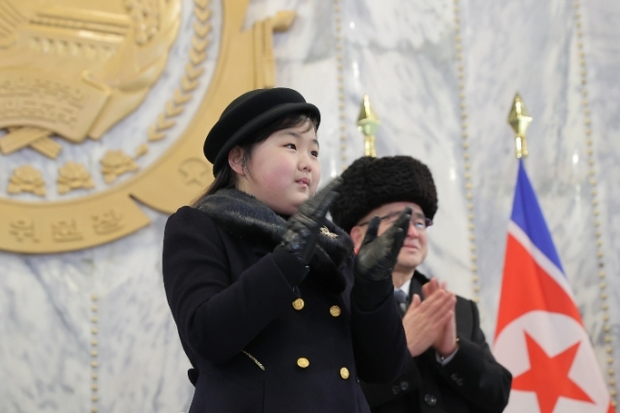
Kim Jong Un’s Teenage Daughter Positioned as North Korea’s Next Supreme Leader, Seoul Intelligence Confirms
AI SUMMARY · SYNTHESIZED FROM 3 SOURCES: Fox News ↗ Reuters ↗ BBC ↗
South Korea’s National Intelligence Service has significantly upgraded its assessment of Kim Jong Un’s teenage daughter, declaring that North Korea has now entered the stage of officially designating her as the hermit kingdom’s next leader, a development that would extend the Kim family dynasty into a fourth generation.
Intelligence Upgrade: From “Likely” to “In Process”
The assessment marks a crucial shift in language from South Korean intelligence officials, who in January 2024 first identified Kim Ju Ae as the “most likely successor.” Now, lawmakers briefed by the NIS say the regime has moved beyond preparation into active designation.
“In the past, the NIS described Kim Ju Ae as being in the midst of successor training,” explained Representative Lee Seong-kweun following Thursday’s closed-door parliamentary briefing. “What was notable today is that they used the term ‘successor-designate stage,’ a shift that’s quite significant.”
The intelligence service cited several concrete indicators supporting this upgraded assessment, including evidence that the young Kim is now voicing opinions on state policy matters and her dramatically increased visibility at symbolically critical events.
The Mystery Girl: What We Know and Don’t Know
Kim Ju Ae’s very identity remains shrouded in uncertainty, reflecting the extreme opacity of North Korea’s ruling family. Her name itself has never been confirmed by Pyongyang’s state media, which refers to her only as Kim Jong Un’s “respected” or “most beloved” daughter.
The belief that she’s called “Ju Ae” stems from a single source: former NBA star Dennis Rodman, who claimed in 2013 that he held Kim Jong Un’s baby daughter during a bizarre diplomatic visit to Pyongyang. Rodman described the North Korean leader as “a good dad” and mentioned the child’s name.
However, even this is disputed. Former NIS intelligence officer Choe Su-yong has claimed Rodman misunderstood the Korean words “jeoae” (저애), meaning “that girl,” and that her actual name is “Un Ju” (은주). A North Korean diplomat who defected in 2023 provided yet another name: “Ju Ye” (주예).
South Korean intelligence estimates she was born in 2013, making her approximately 13 years old, though North Korea has never confirmed her birth date. Intelligence sources indicate Kim Jong Un and his wife Ri Sol-ju likely have three children: an older son born around 2010, Kim Ju Ae, and a younger third child of unknown gender born in 2017.
João Micaelo, who attended school with Kim Jong Un in Switzerland and later reconnected with him, told Radio Free Asia in 2023 that Kim never mentioned having a son, only the daughter appearing in public.
Strategic Public Debut and Escalating Visibility
Kim Ju Ae burst onto the world stage in November 2022 when North Korean media showed her attending the test launch of a Hwasong-17 intercontinental ballistic missile alongside her father. The choice to debut her at a weapons test rather than a cultural or diplomatic event immediately signaled her association with North Korea’s military power.
Since then, her appearances have followed a carefully choreographed escalation:
Military Events: She has attended numerous weapons tests, military parades, and events celebrating the Korean People’s Army, positioning her within the regime’s military power structure.
Diplomatic Occasions: In September 2025, Kim Jong Un brought her to Beijing for his first summit with Chinese President Xi Jinping in six years, a move that stunned analysts by incorporating her into high-level international diplomacy.
Sacred Spaces: Most significantly, in January 2026, she made her first known visit to the Kumsusan Palace of the Sun, the mausoleum where the embalmed bodies of her grandfather Kim Jong Il and great-grandfather Kim Il Sung are displayed.
Cheong Seong-Chang, deputy head of South Korea’s Sejong Institute, described the Kumsusan visit as particularly telling: “It’s a place that symbolizes legitimacy of the North Korean regime. Her visit there ahead of the Workers’ Party congress is a politically orchestrated move.”
The Affection Strategy: Building a Public Image
Recent imagery has emphasized the father-daughter bond in ways unprecedented for North Korean propaganda. During New Year’s Day celebrations in early January, state media broadcast footage of Kim Ju Ae kissing her father on the cheek, a public display of affection virtually unknown in North Korea’s typically austere leadership presentation.
She has been photographed holding her father’s hand at events, standing beside him during military inspections, and occupying positions of honor that would traditionally be reserved for senior party officials or Kim’s powerful sister, Kim Yo Jong.
The honorific language used to describe her has also escalated. State media initially called her Kim’s “beloved” (사랑하는) or “precious” (존귀하신) daughter before upgrading to “respected” (존경하는), a term typically reserved for supreme leaders. In March 2024, she was officially referred to as a “great person of guidance,” placing her on equal linguistic footing with her father.
The Workers’ Party Congress: A Potential Coronation
All eyes are now on North Korea’s Workers’ Party Congress scheduled for late February 2026, the first such gathering in five years. The congress serves as the regime’s primary mechanism for establishing policy priorities, reshuffling officials, and signaling major political developments.
South Korean intelligence officials told lawmakers they are closely monitoring whether Kim Ju Ae appears at the congress and, more importantly, whether she receives an official title or position.
Some analysts, including Cheong Seong-Chang, have speculated that Kim Jong Un might appoint his daughter as the party’s first secretary, the second-highest position in North Korea’s power structure. However, others argue she remains too young for such a prominent formal role and predict lower-level positions if any are conferred.
Her mere appearance at the congress alongside thousands of delegates would itself constitute a powerful signal of her status. If she speaks, participates in decision-making, or is shown consulting with officials, it would confirm the NIS assessment that she has moved beyond passive visibility into active political engagement.
Historical Precedent: Breaking the Pattern?
North Korea has never been ruled by a woman. Since its founding in 1948, power has passed exclusively through the male line of the Kim dynasty: from founder Kim Il-sung to his son Kim Jong Il, and then to grandson Kim Jong Un.
This deeply patriarchal tradition initially led many analysts to dismiss the possibility that Kim Ju Ae could truly be designated as successor. Park Jie-won, who served as NIS director from 2020 to 2022, argued that possible successors had historically been kept hidden from public view until their designation, not paraded before cameras as children.
However, Kim Jong Un’s own succession experience may explain the unconventional approach. He was officially named heir at age 26 during a 2010 party conference, just two years after his father suffered a debilitating stroke. When Kim Jong Il died in December 2011, the younger Kim was thrust into power with relatively little public preparation.
Some analysts suggest Kim Jong Un’s decision to debut his daughter early reflects lessons learned from being rushed into leadership. By establishing her public profile while he remains healthy and in control at age 41, Kim Jong Un may be attempting to ensure a smoother transition than the one he experienced.
The Kim Yo Jong Factor: An Alternative Scenario
Kim Jong Un’s younger sister, Kim Yo Jong, already wields enormous influence in the regime as one of her brother’s closest advisors and most visible representatives. She has delivered major policy statements, met with foreign dignitaries, and is widely considered the second-most powerful person in North Korea.
Her existence complicates succession calculations. If North Korea’s power structure proves unwilling to accept a teenage girl as supreme leader, Kim Yo Jong represents a more immediate female alternative with established political credentials and networks.
North Korea watchers note that Kim Yo Jong’s role could evolve in multiple directions: she might serve as regent during Kim Ju Ae’s minority, emerge as an alternative if designation plans change, or continue as a powerful advisor regardless of who eventually succeeds Kim Jong Un.
Policy Voice: The Latest Evidence
The most recent intelligence suggesting Kim Ju Ae’s designation centers on evidence that she is now providing input on policy matters, according to lawmakers briefed by the NIS. While details remain classified, this represents a qualitative shift from passive attendance at events to active participation in governance.
Representative Park Sun-won told reporters that the NIS assessment was based on “signs of her voicing her opinion on certain state policies,” though specifics were not disclosed for security reasons.
If accurate, this development would align with the traditional North Korean succession model where designated heirs begin learning statecraft through graduated involvement in decision-making processes before assuming full authority.
International Implications and U.S. Dialogue
The succession developments unfold against a complex geopolitical backdrop. The NIS briefing also addressed the possibility of renewed diplomacy between Pyongyang and Washington, noting that North Korea has not ruled out dialogue with President Donald Trump’s administration despite ongoing tensions.
Trump met Kim Jong Un three times during his first term in unsuccessful attempts to secure denuclearization commitments. Trump has since indicated openness to a fourth summit, creating potential opportunities for engagement regardless of who holds power in Pyongyang.
“North Korea has expressed dissatisfaction with the U.S. over the South Korea-U.S. fact sheet and the deployment of U.S. strategic assets on the Korean Peninsula, but it has not ruled out talks with the United States and has refrained from criticizing President Donald Trump,” the NIS reportedly stated.
Skepticism Remains
Despite South Korean intelligence confidence, significant uncertainty persists. Hans Horan of The Hague Centre for Strategic Studies cautioned in December: “Whether her visibility signals the beginning of an orchestrated succession process is entirely unclear, and precedent offers little guidance.”
The extreme opacity of North Korean politics means even South Korea’s well-resourced intelligence service operates with incomplete information. Succession decisions could be affected by numerous unknowns: Kim Jong Un’s health trajectory, the influence of other family members, internal power dynamics among elite factions, and the emergence of Kim Ju Ae’s siblings as they mature.
What appears clear today may shift dramatically tomorrow in a system where information control is absolute and political calculations occur entirely behind closed doors.
A Dynasty’s Fourth Generation?
If Kim Ju Ae does eventually assume supreme leadership, she would represent an extraordinary evolution for one of the world’s most isolated and authoritarian regimes. A woman leading North Korea would shatter the country’s patriarchal traditions while simultaneously extending the Kim family’s dynastic control into its eighth decade.
For now, the world watches and waits for signals from Pyongyang’s upcoming party congress. Whether Kim Ju Ae emerges as North Korea’s designated future leader or whether the current speculation proves premature, her remarkable visibility has already guaranteed her place in the hermit kingdom’s tightly controlled historical narrative.
The question is no longer whether Kim Jong Un is preparing someone to eventually succeed him. The question is whether that someone is his teenage daughter, and if so, whether North Korea’s power structure will accept her when the time comes.








