
Global Crypto Regulation Advances as Governments Seek Greater Investor
AI SUMMARY · SYNTHESIZED FROM 2 SOURCES: Blockchain Council ↗ Informed Clearly ↗
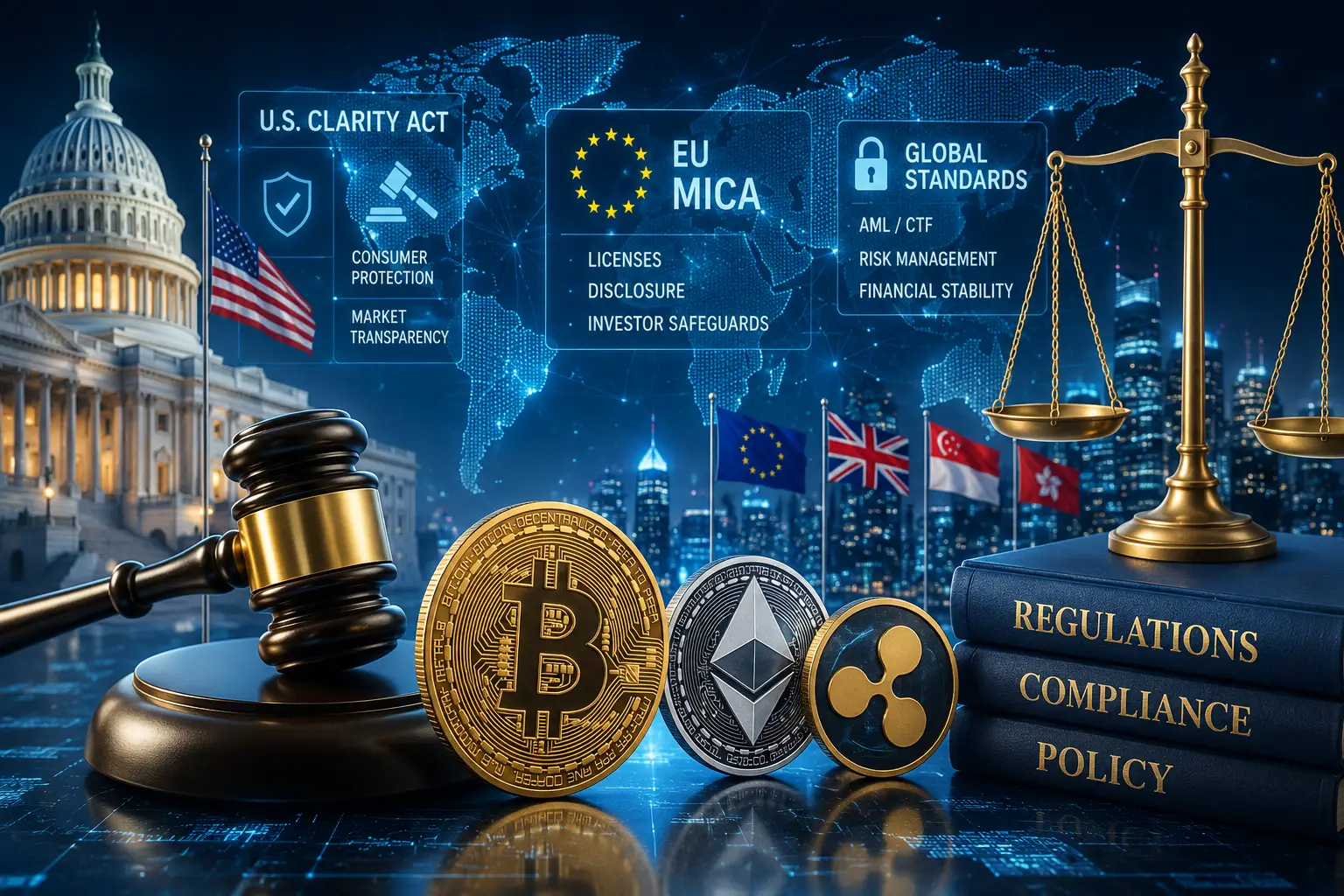
Governments around the world are accelerating efforts to establish clearer rules for cryptocurrencies as digital assets become more integrated into the global financial system. Recent developments in the United States, Europe, and Asia reflect a broader shift from fragmented oversight toward comprehensive regulatory frameworks focused on investor protection, market transparency, and financial stability.
What Happened?
Crypto regulation has entered a new phase as lawmakers seek to balance innovation with stronger consumer safeguards.
In the United States, lawmakers are advancing the Clarity Act, legislation designed to establish a comprehensive regulatory framework for digital assets. The proposal aims to clarify which federal agencies oversee different types of crypto assets, reduce legal uncertainty, and strengthen investor protections. Congress is pushing to move the legislation forward before its August recess.
Meanwhile, the European Union continues implementing its Markets in Crypto-Assets (MiCA) framework, one of the world’s first comprehensive crypto regulatory systems. The framework introduces licensing requirements, reserve standards for stablecoins, disclosure obligations, and enhanced consumer protections for crypto service providers.
Several Asian financial centers, including Singapore and Hong Kong, have also expanded licensing and compliance requirements as they position themselves as regulated hubs for digital asset businesses.
Why Governments Are Tightening Rules
The cryptocurrency market has matured significantly over the past decade.
Today, institutional investors, banks, payment companies, and asset managers increasingly participate in digital asset markets, making regulatory clarity more important than ever.
Recent regulatory efforts generally focus on:
- Protecting retail investors
- Preventing fraud and market manipulation
- Improving transparency
- Strengthening anti-money laundering (AML) compliance
- Creating consistent licensing standards
- Supporting responsible innovation
Regulators argue that clearer rules could increase confidence among both consumers and institutional investors while reducing systemic risks associated with rapidly growing digital asset markets.
Impact on Crypto Businesses
For exchanges, wallet providers, stablecoin issuers, and blockchain startups, the evolving regulatory landscape means greater compliance responsibilities.
Companies may now need to:
- Obtain operating licenses
- Meet capital and reserve requirements
- Improve cybersecurity standards
- Increase financial reporting
- Strengthen customer verification procedures
- Enhance operational transparency
Although compliance costs may increase, many industry participants believe regulatory certainty could encourage broader institutional adoption over the long term.
What It Means for Investors
For investors, clearer regulation may provide several benefits.
Potential advantages include:
- Better consumer protections
- Greater transparency
- Reduced fraud risk
- Improved oversight of exchanges
- Higher institutional participation
- Increased confidence in regulated digital asset products
At the same time, stricter compliance requirements could reshape parts of the cryptocurrency industry as businesses adapt to new legal standards.
Global Trend Toward Regulation
Although approaches vary by jurisdiction, the overall direction is becoming increasingly consistent.
Major economies are moving toward:
- Licensing crypto businesses
- Regulating stablecoins
- Defining digital asset classifications
- Strengthening AML enforcement
- Increasing disclosure requirements
- Coordinating international regulatory standards
Rather than restricting cryptocurrency entirely, many governments now appear focused on integrating digital assets into existing financial systems through clearer legal frameworks.
Key Takeaways
- Governments worldwide continue expanding cryptocurrency regulation.
- The U.S. Clarity Act aims to establish a comprehensive federal framework for digital assets.
- The European Union continues implementing MiCA regulations.
- Regulators are prioritizing investor protection and market transparency.
- Greater regulatory certainty may encourage institutional adoption over the long term.
Why This Matters
Regulation is becoming one of the most important drivers of cryptocurrency adoption.
Clear legal frameworks may help digital assets gain wider acceptance among financial institutions, businesses, and retail investors while reducing uncertainty that has historically slowed industry growth.
As governments continue refining their approaches, regulation is likely to play a central role in shaping the next phase of the global crypto economy.
AI Transparency Notice
This article was generated by AI using publicly available reporting from trusted news organizations and industry publications. APNews.ai does not conduct original reporting. Readers are encouraged to review the original source articles for complete context and future updates.








