Deportation Flights, Deadly Shootings and Lawsuits: Inside Minneapolis’ Months-Long Immigration Crackdown
Every morning, planes take off from Minneapolis–St. Paul International Airport carrying shackled passengers. Their hands and feet bound, they are flown first to detention facilities in Texas, then, in many cases, out of the country entirely. The flights are not announced. The passenger counts are not published. The names of those aboard are kept from public view.
What began in December as a targeted federal immigration enforcement operation in Minnesota has grown into what the Trump administration calls the largest interior deportation campaign in American history — and what critics, civil rights attorneys and state officials increasingly describe as an unchecked surge that has left two civilians dead, hundreds of lawful refugees detained, and an entire city on edge.
An Operation That Kept Expanding
The Department of Homeland Security first announced Operation Metro Surge in early December 2025, initially framing the effort around allegations of social services fraud with ties to Minnesota’s Somali-American community. But the scope of the operation widened rapidly.
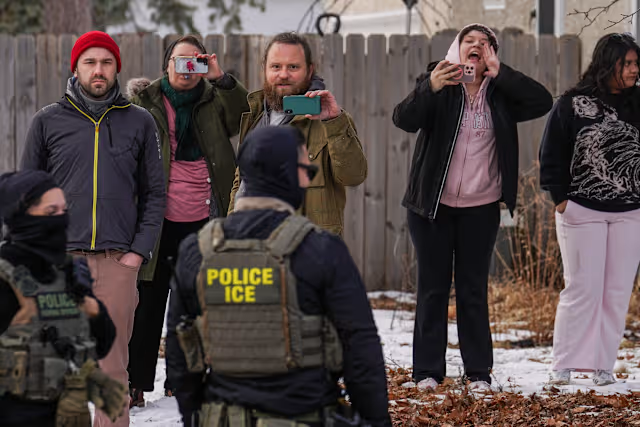
By January 6, DHS had deployed as many as 2,000 Immigration and Customs Enforcement officers and U.S. Customs and Border Protection agents to the Minneapolis–St. Paul metropolitan area. ICE Acting Director Todd Lyons publicly described it as the agency’s single largest immigration operation ever conducted. DHS Secretary Kristi Noem personally joined agents in the field, appearing in tactical gear in a widely circulated video as agents arrested a man in St. Paul.
“You will be held accountable for your crimes,” Noem told the handcuffed man in the footage.
The White House and DHS announced a milestone of more than 4,000 arrests in Minnesota as of early February, with Border Czar Tom Homan citing what he called unprecedented new cooperation from local law enforcement. Homan said local officials were allowing ICE to take custody of individuals before they were released onto the streets — a shift he credited to sustained federal pressure.
Questions About Who Is Being Arrested
Federal officials have consistently described their targets as dangerous criminals — gang members, murderers, fraudsters and threats to public safety. But an examination of the operation’s actual arrests has complicated that picture considerably.
A review of early arrest data showed that none of the individuals DHS highlighted as the “worst of the worst” in one release were Somali, despite the operation’s stated focus on Somali-linked fraud. Of those arrested whose countries of origin were identified, only 23 were from Somalia, and none had ties to the social services fraud cases under investigation.
A class-action lawsuit filed by refugees and advocacy groups alleged that more than 100 refugees with no criminal background had been unlawfully arrested, with many transferred to a federal detention facility in Texas. Among those detained have been restaurant workers, hotel employees, Target store staff, families with children and, according to advocates, at least some Native Americans stopped during enforcement sweeps.
Data from the University of California Berkeley’s Deportation Data Project indicates that in the first nine months of Trump’s second term, roughly 75,000 people arrested by ICE nationally had no criminal record — more than a third of all ICE arrests during that period.
Immigration attorney Luke Srodulski, who represents several detained clients in Minnesota, said the legal basis being used to hold refugees is an obscure statute not designed for this type of enforcement. “I ultimately think the goal is cruelty,” he said, adding that he believes officials searched through statutes specifically to find a mechanism they could repurpose for mass detention.
Two Civilians Killed
The sharpest point of controversy has been the fatal shooting of two people by federal agents in January.
On January 7, Renée Nicole Macklin Good, a 37-year-old American woman and mother of three, was shot and killed by ICE agent Jonathan Ross in Minneapolis. Good was in her car when Ross approached on foot. As her vehicle began to move, Ross, standing at the front-left of the car, fired three shots. Federal officials, including President Trump, said the agent acted in self-defense and that Good had run him over. Video reviewed by multiple news outlets appeared to show the car turning away from Ross as he fired.
Her death triggered a wave of protests and calls for accountability. Leaders in the DOJ’s Civil Rights Division declined to open a constitutional investigation, prompting more than a dozen federal prosecutors in Minneapolis and Washington to resign in protest.
On January 24, Alex Pretti, a 37-year-old ICU nurse, was fatally shot while participating in a protest on Nicollet Avenue. Video obtained by reporters appears to show Pretti using his phone to record officers and going to the aid of a woman who had been pushed. He was then pepper-sprayed, struck in the head, and forced to the ground. An officer removed a lawfully carried handgun from his waistband — Pretti had a valid permit — and moments later, as many as 10 shots were fired, killing him. Federal officials again defended the shooting as self-defense.
The two deaths intensified protests across Minnesota. Hundreds of businesses staged a day of closures in solidarity with affected communities.
Legal Challenges Mount
Minnesota Attorney General Keith Ellison, along with the cities of Minneapolis and St. Paul, filed suit against DHS seeking to halt the ICE deployments, arguing the operation violates constitutional protections and infringes on state sovereignty. Additional legal challenges were filed on behalf of individuals alleging racial profiling during stops and arrests.
Courts have begun scrutinizing aspects of the operation, though federal officials have so far continued enforcement activities while litigation proceeds.
Legal experts and advocacy groups have noted that while ICE agents do have authority to question and detain people they believe are in the country unlawfully, the manner in which that authority is being exercised has raised serious legal and civil rights concerns. Advocates say the speed and scale of operations has made it difficult for people to understand or exercise their rights in real time.
A City Tracking Its Own Deportation Flights
With the federal government publishing little data on the scope of its operations, residents and advocacy groups have turned to their own methods to document what is happening.
Aviation enthusiast Nick Benson has been standing at the Minneapolis–St. Paul airport day after day, counting the number of people being loaded in shackles onto federally chartered flights. His counts have become some of the only ground-level data available on how many people are actually being removed from the state.
Savi Arvey, who oversees ICE Flight Monitor for the human rights advocacy group Human Rights First, said her team can track the flights themselves but has no visibility into who is on board — making observers like Benson essential.
The Trump administration has not responded to NPR’s request for the number of people detained and deported out of Minnesota during the operation. ICE detainee flights from Minneapolis have more than doubled compared to the same period a year ago, according to flight tracking data.
Federal Officials Signal Partial Drawdown
As legal pressure and national scrutiny intensified, the White House announced in early February that Border Czar Homan would begin reducing the federal agent presence in Minneapolis, citing the operation’s successes and new cooperation from local law enforcement.
Homan credited the drawdown to what he called an unprecedented number of counties now communicating with ICE and allowing the agency to take custody of individuals before their release — framing reduced deployment as a sign of achievement rather than retreat.
Critics pushed back. Immigrant rights organizations said the pullback announcement masked ongoing enforcement activity and that families throughout the Twin Cities remained fearful of leaving their homes. Several attorneys reported that their clients continued to be detained and transferred out of state even as federal officials announced the beginning of a drawdown.
The operation remains active. Flights continue to depart each morning.